Monday, December 10, 2018

Threadlace

Most machine knitters are familiar with the method of threadlace.
MC and L button pushed in on Brother machine
There is yarn in feeder A and a thin yarn or thread in feeder B. Selected needles knit only with the yarn in feeder B, the thread, and non selected needles are knitted with both, yarn and thread. As the thread is so thin the knitting looks like lace.

The yarn in feeder B was 2 strands of serger thread, yarn in feeder A Tamm Estilo. The top as an appearance of a lace top.

But there is more to threadlace.
The next example is a cardigan where thread and yarn are identical. The purl side is used as front side.


The next is only a small sample. Thread in feeder A and yarn in feeder B, again purl side as front. Every few rows the thread is picked up and rehung.


Thursday, September 13, 2018

Lace top with skirt

I used a model from Machine Knitting Today, December 1994 and then modified to my liking.  I always draw the shape in Desingaknit, also the lace pattern.
The skirt is stockinette, darts on the waist. Bottom is started with  crochet cast on and then knitted to left. Again crochet cast on behind stitches and knitted to left, a total of 3 times.


Top has beads at the bottom front, back and sleeves.


Sideways knitted top

Sideways knitted top

I got the idea from here: https://www.liveinternet.ru/users/4149161/post364666433/
Translating software is not very good, but the pictures were enough to get the idea.
I used Tamm Perla. The bottom increases and decreases are done with a 20 prong transfer tool, shoulder slopes with 12 prong and neck edge with 6 prong.


Tuesday, April 17, 2018

Filet lace curtain panel

Filet lace curtain panel


This is the final result knitted on Brother KH940.
To achieve this I used a simple picture without many details.

The lace pattern in the background has 6 passes with the lace carriage and 4 with the knitting carriage. So in order to not distort the picture I stretched it by a factor of 1.5 in Photoshop. Any picture editing software works. Then opened up in Graphic Studio of DAK and transformed to a stitch pattern.
I then drew in the white areas the stitch pattern of the background. First I drew a small stitch pattern for the lace background, then inverted it because it seems I can draw only on the white non selected needle area. But as later for the finished pattern the animals need to be white, non selected, I again had to invert the whole pattern. Maybe there is an easier way, but this worked well.
final lace pattern

inverted lace pattern

and here is the final DAK stitch pattern.
144 st x 804 rows with lace carriage, 562 rows with knitting carriage. I started with a seam and ended with a seam to be able to hang it with a rod. Yarn was Bonita 100% mercerized cotton, finished size 22 x 37".


Here another set of curtains


Tuesday, January 9, 2018

Short rowing to achieve geometric shapes


Will do a demo tomorrow for my knitting club about short rowing geometric shapes, spirals and miters.

I got the idea from an article by Susanna Lewis in Machine Knitter's Source Jan/Feb and Mar/Apr 1998 called "Split Miters". She also describes the method in her book "A Machine Knitters Guide to Creating Fabrics"
You get a miter by casting on over a certain number of needles, then short rowing down to a few needles, then adding those needles again in the same intervals. For a spiral you would add all needles at once after the short rowing down.


Monday, November 20, 2017

2-Color Brioche

2-Color Brioche

This was knitted on Brother KH940 with ribber and color changer. This method is very similar to a fisherman's rib. Normal cast on for 1x1 rib, then yarn is changed every 2 rows, and every 2 rows settings are changed on main carriage and ribber carriage. Two rows tuck in both directions on main carriage, all knitted on ribber. Then two rows tucked on ribber in both directions while main carriage knits all stitches.
2 rows tuck on main bed in color 1

2 rows tuck on ribber in color 2

front

front and back

reversible hat

Hat: 140 stitches, 70-70,  1x1 rib for 46 rows, then change to tuck and knit another 90 rows, change back to 1x1 rib for 2 rows, transfer ribber stitches to main bed on needles that already have a stitch, 4 rows stockinette with tighter tension and take off to gather top. did the side seam as flat as possible to make it reversible. the second dark red side shows a few flaws where the stitches were not knitted off the main bed needles completely.
Yarn was a 2/12 acrylic with T=5.

Sunday, August 20, 2017

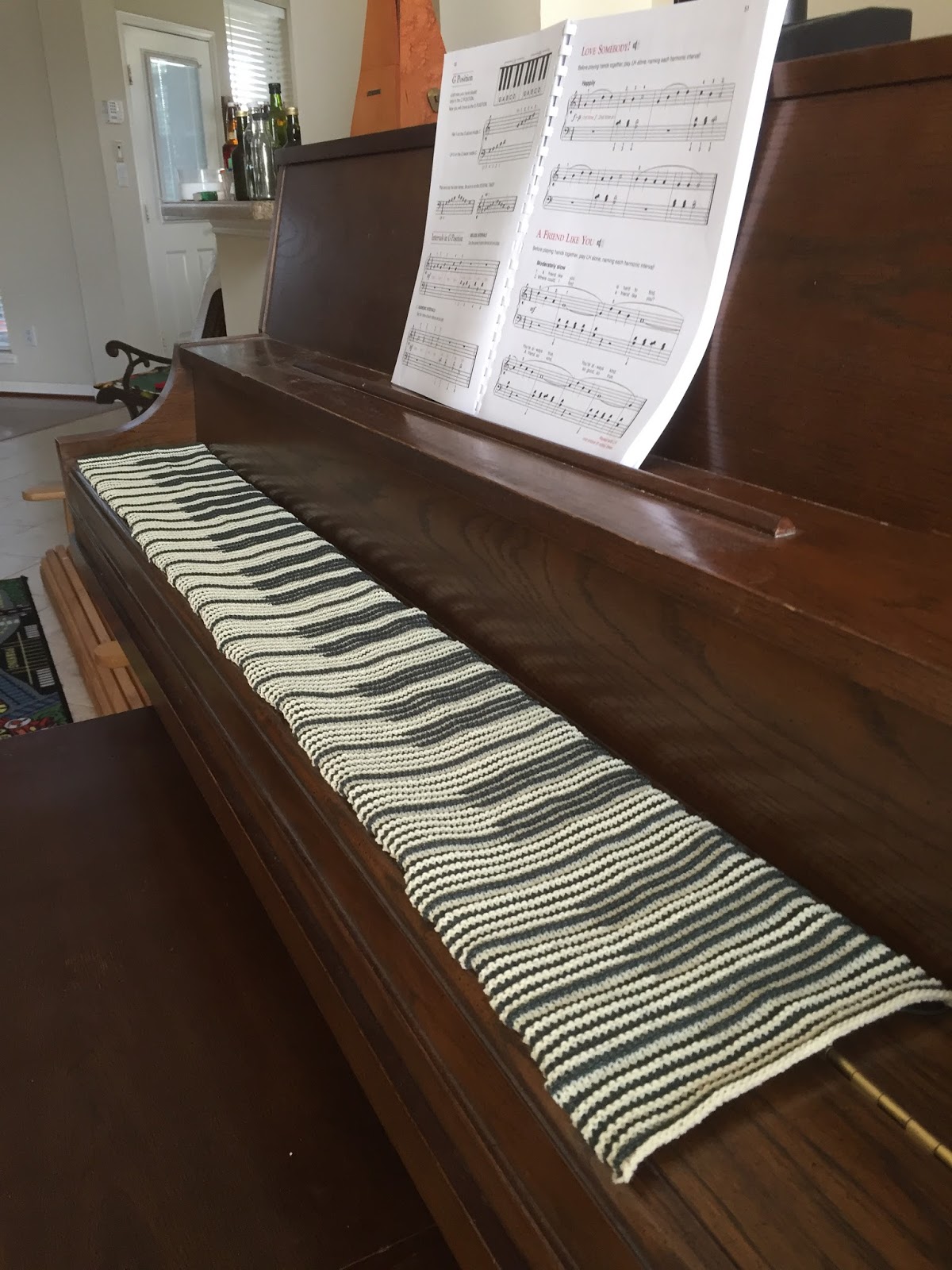
Illusion or Shadow Knitting

I had seen a lot on the internet, but also described in books, mostly it is for hand knitting, not machine knitting.

Vivian Høxbro, Shadow Knitting, Interweave Press, 2004
Margaret Radcliffe,The Essential Guide to Color Knitting Techniques: Multicolor Yarns, Plain and Textured Stripes, Entrelac and Double Knitting, Stranding and Intarsia, Mosaic and Shadow Knitting, 150 Color Patterns, 2nd Edition 2015


In hand knitting it is easy to knit or purl. I used the garter carriage on a Brother 940 and drew the pattern in DAK.

First sample:

cotton
cast on 66 st with T=5, then knit with GC and T=6
mirror setting Variation key 2
131 rows


seen from top


seen from the side


This picture is from the website. Knitting starts at bottom with  each row knitted 4 times, 2x in light color and 2x in dark color. The description says to alway knit the front row and to either knit or purl the back row. For the shaded areas that should look dark the back row is knitted with the dark color, making a purl bump that will be visible. For the light colored shading the back row is knitted with the light color.


Here is the DAK pattern


To knit this with garter carriage. Cast on from right to left in light color. Then knit row 1 and 2 with garter carriage. As there are no selected needles on the first 2 rows, both rows knit normally. Then for the 2 dark color rows, the first row is knitted, the second row all stitches are turned with garter carriage. This corresponds to knitting the back row by hand, instead of purl. These first 4 rows show as a dark ridge from the other side (away from knitter). In the next 12 rows (4x3rows) the second light color rows has the stitches turned with garter carriage, so this shows as 3 white bumps, the white piano keys.


seen from the side

very little pattern seen from top


And here a top from Vivian Høxbro's Shadow Knitting, slightly modified.